Where We Work
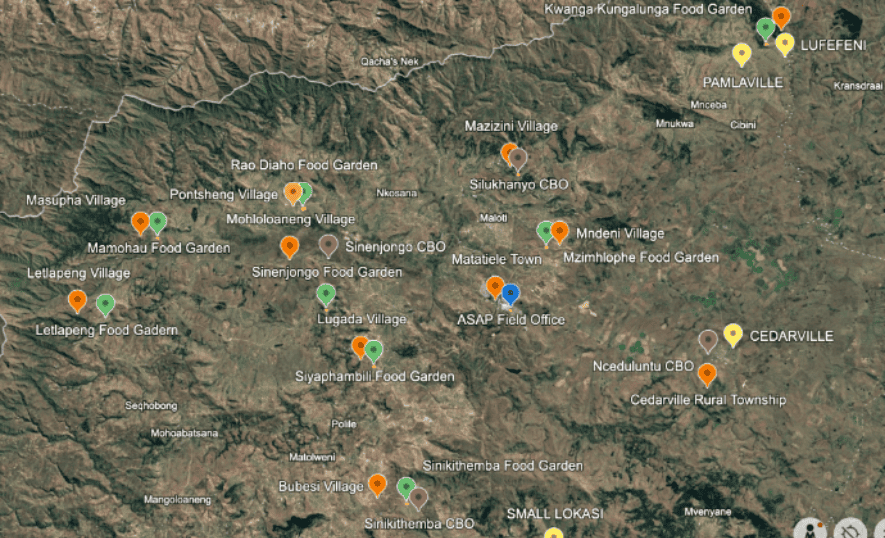
Last-mile villages of the Eastern Cape — where South Africa’s grasslands meet the Lesotho mountains.
The region
ASAP works from a field office in Matatiele, reaching into some of the country’s most isolated communities, and among the least reached by mainstream development.
It’s a place development maps often skip over. Most villages have no surfaced roads, no indoor plumbing, and no piped water. Cell signal is patchy at best, with households here reporting reliable connection an average of two days a week. A clinic, school or Home Affairs office is rarely a short trip. These are reasons ‘last-mile is the right word, and why so few organisations reach this far.
The reality
The numbers are hard, and we don’t look away from them:
- 77.4% unemployment across rural Eastern Cape (2026).
- 76% of households don’t have enough nutritious food, and nearly two-thirds of children go hungry regularly (2026).
- In Mzongwana village, more than half of households have to cut back meal sizes, and 26% run out of food entirely (our own household hunger survey, May 2026).
- Eastern Cape carries one of the country’s heaviest HIV burdens, and the toll shows up here in high numbers of orphaned and vulnerable children, often raised by grandmothers.
- Close to the Lesotho border, with no public transport and the cost of travel to Home Affairs out of reach for most families, many children and adults grow up without an ID or birth certificate, locked out of graduating school, healthcare and social grants.But isolation hasn’t erased what’s here. Strong traditional leadership. Land. Tight community bonds. Women and youth ready to lead, given the training, the trust and the support to do it. That’s what we build on.
Our villages
We work in village ecosystems, alongside the women, tribal leadership and young people already leading change there. In 2026, ASAP is active in 11 villages across the Alfred Nzo District (up from just 4 in 2022) through community-based organisations and cooperatives that are locally owned and run:
| Village | Community Group | What the name means |
|---|---|---|
| Lugada village | Siyaphambili Ngendyebo Coop | We Go Forward with Abundance |
| Bhubesi village | Sinikithemba HBC | "We Bring Hope" |
| Mehloloaneng village | Sinenjongo NPC | "We Have a Purpose" |
| Pontseng village | Rao Diaho Coop | "Rise" |
| Letlapeng village | Letlapeng Community Project | "The Rock" |
| Mdeni village | Mzimhlophe Coop | "Bright Homestead" |
| Mngeni village | Kwanga Kungalunga Coop | "May It Be Well" |
| Cedarville village | Nceduluntu CBO | "Help Our Community" |
| Mazizini village | Silukhanyo CBO | "We Are the Light" |
| Pamlaville village | site of a new community borehole, 2026 | |
| Lufefeni village | site of a new community borehole, 2026 | |
South Africa
- 8.23 million people living with HIV
- 19.5%adult HIV prevalence
- 24% adult female HIV prevalence
- Since 2002, the number of persons living with HIV
Sources: StatsSA 2020, 2021; IRR 2019
Eastern Cape
- 1.9 out of three million children regularly going hungry
- 79% of children classified as multidimensionally poor
- 23% of the nation’s HIV positive population
- Alfred Nzo District is South Africa’s poorest municipality
Sources: StatsSA 2020, 2021; IRR 2019
Newsletter Sign-Up
Keep in touch.